Building something close to my heart
Niyora, month by month. The honest version.

I built a Mac app to help me stop
The first thing I built was for me. Knowing when to stop is hard, and hardest during PMS, exactly when I most needed to. So I made something that helped me stop.
- Shipped a small macOS app that lives in the menu bar, notices when you have been at the screen too long, and offers 60 seconds of calm.
- Built it around the thing I needed most: a nudge to step away. During PMS, when stopping is hardest and matters most, it was what made me.
- Kept it clean of data. No accounts, no tracking, nothing leaves your device.
I made it reliable
A calming reminder that vanishes after a restart is not calming. May was about making Niyora something you could actually depend on.
- Added auto-updates and made the app relaunch itself after a restart. A reminder that disappears is useless.
- Ported it to Windows so it was not only for people on a Mac.
- Asked a harder question: if breathing helps, can I prove it? Started an iPhone app to read your heart rate, on device only.
- Kept the stress signals to what stays on your phone, like screen time. I turned down keystroke and mouse tracking because it reads as surveillance.
I cut my favorite feature
The heart-rate idea was the most exciting thing I had built. It also was not accurate enough to be honest. So I cut it.
- Ran a ten-day self-experiment: the watch would sense stress each hour, then measure heart-rate variability.
- It came back with 255 heart-rate samples and no usable variability. The Apple Watch cannot measure stress reliably enough to build a promise on.
- So I cut it. Measuring the heart was interesting, but it was never the point. I kept the breathing.
- Moved the breathing experience onto iPhone and let it stand on its own.
I launched on the App Store
On June 21, Niyora went live on iOS. I shipped it simple on purpose.
- Cut hard to ship simple: hid the mood check-in, dropped scheduled notifications and Mac sync, so v1 could just work.
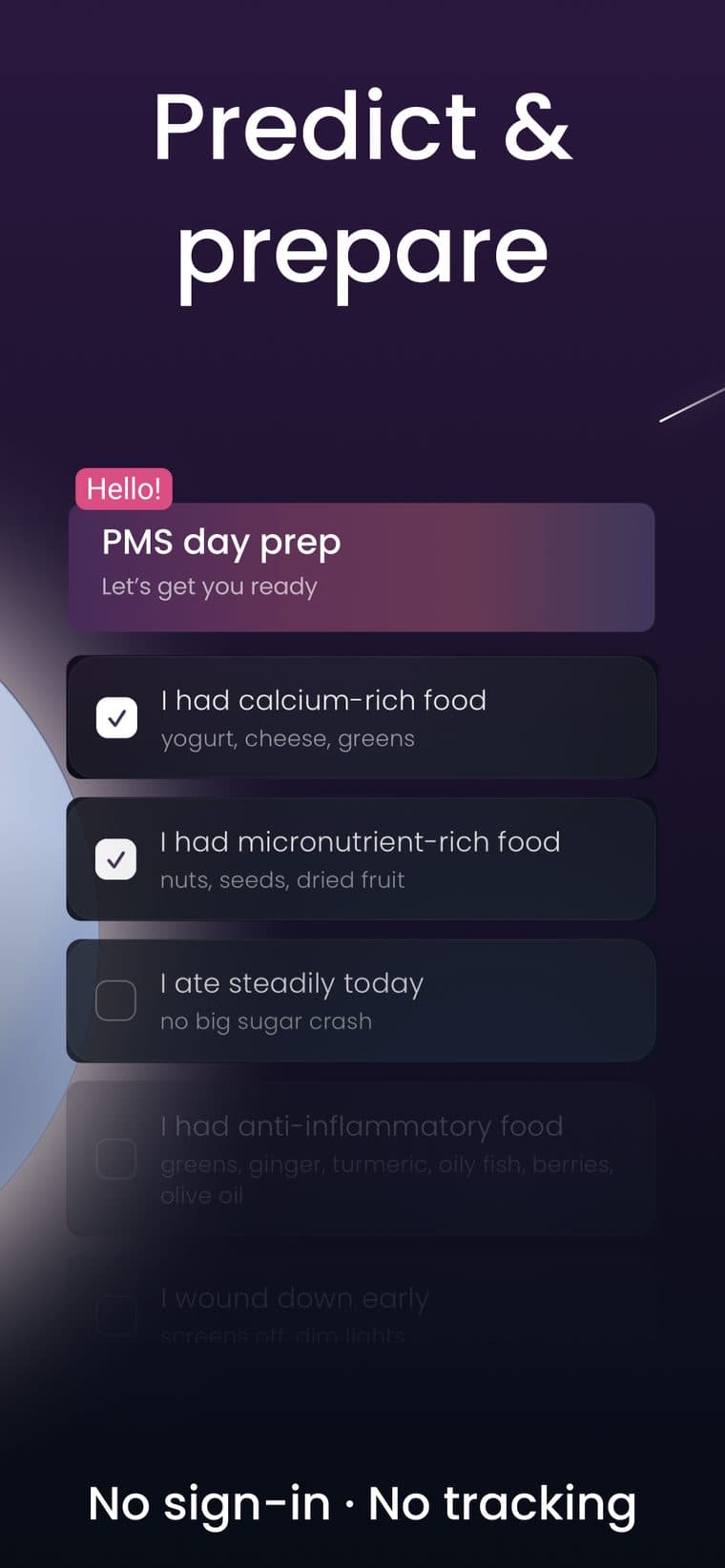
- Shipped v1 on June 21: 15 calming activities and cycle awareness, still no sign-in and no tracking.
- Turned to the psychological side of PMS and PMDD. Almost every app tracks it. Almost none explain it.
I stopped waiting to close the gap
I was focused on stress, but I knew my stress was really about hormones, and life does not wait for PMS. Telling a friend my goal, I heard myself say that one day, with enough resources, I would fund women's research. Then it clicked. Who is stopping me now?
- Saw the gap I could not unsee: the distance between what I know as a doctor and what the research actually says. I wanted to map it exactly.
- Realised I did not need a fund or anyone's permission to start. I could read the evidence myself, right now.
- Pointed the whole project at PMS and PMDD as a real question, not just a calm button.
I read 1,800 papers first
I did not want to add activities that sounded nice. I wanted the ones the evidence backs. So I read the evidence.
- Built a research tool that harvested roughly 1,800 peer-reviewed studies from Europe PMC, deduplicated by DOI and graded by study type, from randomised trials down to contested claims.
- Read across them with a doctor's eye. I practised medicine in India, so I could tell what is proven from what is only repeated.
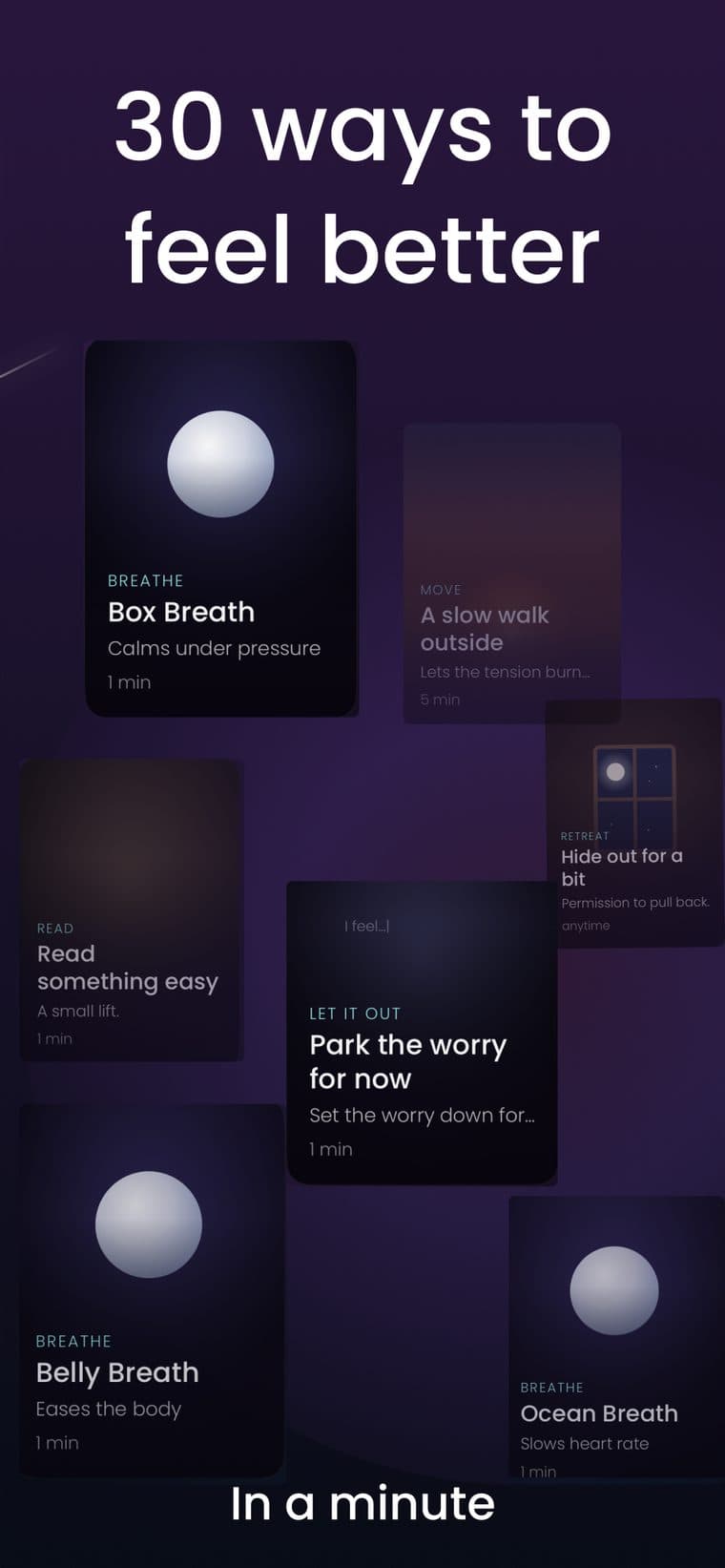
- Shipped v2 on July 1: 30 calming activities, personalised to where you are in your cycle.
- The research did not sit in a folder. It became the product, and now a practice for owning your emotions across the cycle, not another symptom tracker.
I found the pattern
Reading across the papers, one thing kept surfacing. The relief that lasts is not a supplement or a tracker. It is learning to regulate the emotion itself.
- Saw it in the evidence: the psychological symptoms of PMS respond to emotion-regulation skills, more reliably than to most quick fixes.
- Chose the niche almost no app touches. Everyone tracks the cycle and consoles you. Almost nobody explains what is happening and helps you act on it.
- Refused to make her log what we already know. Almost every woman with PMS gets irritable, so why ask her to add it every month? I wanted no more tracking, just the solution.
- Sorted 2,644 screened findings into a content bank of eight stations, from understanding your body to relationships, so the research had a shape before it had a screen.
I wrote the vision so I would not sprawl
A domain this open invites scope creep. So before building the practice, I wrote down what Niyora is, and what it refuses to be.
The vision, one loopPredict the vulnerable window, catch the stress, restore a sense of safety, prove it worked, and learn what works for her.
- Named the frame that guides every screen: your hormones are normal, your brain is just more sensitive to them. Not a flaw, not an imbalance, not your fault.
- Drew the scope narrow and deep, not wide. Help with what a woman can actually move: sleep, food, stress, and the emotion skills. The research does not expire, the runway does.
- Cut screening for ADHD, thyroid, and PCOS from the first version. Naming a condition edges into diagnosis and liability, so it becomes gentle education and a nudge to see a doctor, never a score.
- Wrote the line I would not cross: normalise and explain, never pathologize. No shame engine, no streak to break.
I gamified learning each emotion
Then I turned the science into something you play, not read. Each emotion is a short game where the skill is real, not trivia.
- Built the core move: read how activated she is, then pick the response that fits. The twist is that the same move is right when she is simmering and wrong when she is flooded, so reading her own intensity is the skill.
- Wrote three emotions first: irritability, anger, and sadness. Each one teaches what it is, how to handle it with another person, and where the myths hide.
- Made the interpersonal beat honest: say the real thing, just not mid-flood. Saying nothing is drawn as a bad outcome, so the game never trains self-silencing.
- Grounded every level in evidence. Venting at a pillow makes anger worse, not better. One small action lifts a low mood more than sitting and turning it over.
I taught it for the workplace
PMS does not stay home. The clearest evidence is about what it does to work, so I wrote three lessons for it.
- Covered what the research actually shows: over years, premenstrual disorders track with more sick leave and job loss. Not proof of cause, but the strongest signal we have.
- Named the real drag. Mood and focus, more than pain, are what pull down a working day, and they show up as being present but depleted, not as days off.
- Kept it honest about limits. Where the problem is bias or harassment, Niyora names it and backs her up. It will never pretend she can train her way out of someone else's discrimination.
I made it about relationships
The moment that keeps people is not a chart. It is a month where they did not fight. So the hardest track is the closest one.
- Built the first question: is this the PMS turning up the volume, or a real thing that deserves a real conversation? A quick read keeps her from dismissing valid feelings as hormones.
- Wrote the heads-up message: a note to your partner, in your words, about how you want the week handled. Her voice, her edit, her tap to send. Never automatic, and never an apology for her body.
- Wrote the repair: how to come back after a fight. Step away while it is hot, then reach out once it passes. The timing is the whole lesson, drawn from the same science as the games.
- Kept it all playable and all sourced, so even the softest topic has a spine.
I brought in AI, privately
Then I added an AI, with one hard rule that everything else bends around: it never leaves the phone.
- Runs on device, offline, with no account. Nothing you say to it is uploaded, because the whole promise of Niyora is that nothing leaves your phone.
- Kept it narrow. It is for emotion regulation, not a general chatbot. It reads the emotion and the situation and suggests the next best step, grounded in the same evidence as the games.
- Made it calm you first, then help you think. Once you are settled, it offers ways to handle the moment, specific to the feeling and specific to what you are facing.
- Drew the safety line in code. Anything near crisis routes straight to a helpline, never to the AI.
What is next: beta, then launch
None of this ships on a guess. It ships after the people it is for have torn into it.
- Next: sit down with women who know PMS from the inside and watch them actually use it, over Mexican food. The treat is on me.
- Take the honest reactions, cut what does not land, and iterate until it earns the return visit.
- Then launch the practice the same way I shipped the calm tool: quietly, and only when it is ready.
What I learned along the way
A few things I did not know when I started, that I would tell anyone building in a tender space.
- Keep the game, remove the test. Adults are not put off by difficulty, they are put off by fake stakes and being graded on their feelings.
- Tag every claim by how sure you are. Ship only what is verified, and keep the myths around as wrong answers, precisely because they sound scientific.
- Let people coach a friend, not themselves. We reason more kindly, and more wisely, about someone else's feelings than our own.
- Leave the ceiling unreachable. You cannot fully prepare for something unpredictable, so the progress ring never reaches 100, and that honesty is the whole message.